.svg)


While the Asia Pacific region has made significant strides toward malaria elimination, gains remain uneven. Traditional approaches often fall short of reaching the most marginalized and disadvantaged groups, leaving them vulnerable to the preventable yet devastating effects of malaria. However, prevailing gaps persist not for a lack of political will, but rather the systemic discrimination as well as underrepresentation of marginalised and disadvantaged groups in the data that inform decision-making processes.
Specific subsets of the population – pregnant women, mobile and migrant populations, people living in remote and border areas, ethnic minorities, and persons with disabilities, among others – remain disproportionately at risk of malaria. This vulnerability is further exacerbated by deep-rooted socioeconomic and cultural barriers that limit their access to preventative measures, timely diagnosis, and effective treatment. Despite growing commitments to health equity globally, significant gaps remain between policy intentions and implementation realities. While Gender Equality, Disability, and Social Inclusion (GEDSI) principles are increasingly being endorsed in national malaria strategies in recent years, shortfalls in the collection, analysis and use of disaggregated data to support inclusive decision-making continue to impede progress on the ground.
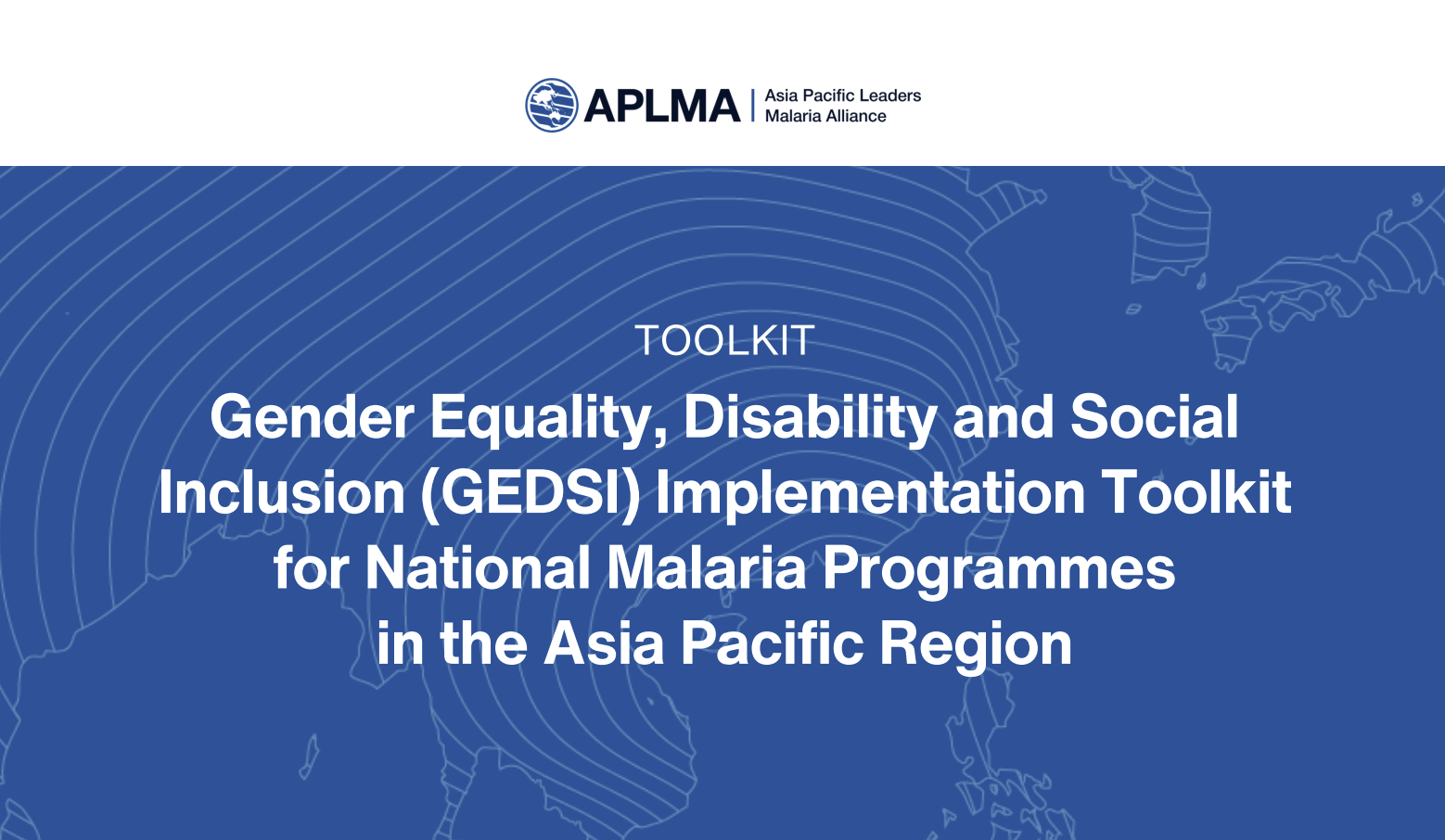
Recognising the urgency to bridge GEDSI gaps in malaria programmes in the region, the Asia Pacific Leaders Malaria Alliance (APLMA) developed the GEDSI Implementation Toolkit for Malaria Elimination – a practical, implementation-focused resource designed to support stakeholders across Asia Pacific who are involved in malaria control and elimination at every level of the health system to operationalise GEDSI into malaria policies and programmes.
A Practical Toolkit for Real‑World Settings
Moving beyond theoretical frameworks, the GEDSI Implementation Toolkit for Malaria Elimination offers step-by-step guidance that can be contextualised across the region’s diverse health, epidemiological, and social landscapes. The toolkit was developed through extensive consultations with GEDSI, malaria, and development stakeholders and experts across the region, ensuring the guidance is grounded in operational realities, country-level programmatic experience, and the latest evidence-based best practices.
Specifically, the toolkit will provide:
- Simple frameworks to identify who is being missed and where gaps persist
- Easy-to-use tools to examine barriers to access and uptake of malaria services by vulnerable groups
- Practical strategies to design inclusive interventions that can better reach underserved populations
- Guidance on embedding GEDSI into malaria surveillance, programme planning, and implementation
By complementing programmatic decision‑making processes, the toolkit provides stakeholders with an actionable framework to identify where equity and inclusion gaps persist, and how GEDSI approaches can be adopted to address the underlying structural and social drivers of malaria among underserved groups. At its core, the toolkit is designed to support better GEDSI-sensitive decision‑making, with the aim of making malaria interventions more inclusive, equitable, and responsive to population needs.
Leaving No One Behind
As the global health landscape evolves and the optimisation of resource allocation becomes increasingly critical, the case for implementing inclusive approaches has never been clearer. APLMA encourages programmes and partners to utilise the GEDSI Toolkit to strengthen national malaria strategies, ensuring that progress toward elimination is shared by all while advancing broader health and development agendas. Malaria elimination is possible, but only when we ensure that no one is left behind.
Access APLMA’s GEDSI Implementation Toolkit below.
Explore GEDSI data here: https://www.aplma.org/ourwork/gedsi
You may also like